OCN Fribourg practical test: 5 classic traps to avoid in town and beyond
Priorities, 30 zones, A12 exit, gradients and independence: five situations that often catch candidates — and how to prepare.
Editorial AZUL Auto-École®
Some candidates arrive at the OCN knowing the Highway Code inside out. They have revised, completed their hours, even slept well the night before. And yet they fail.

Not because they drove badly — because they did not know the ground.
Fribourg is not a neutral city. Its slopes, meeting zones and suburban roundabouts are part of the test route, whether you like it or not. The expert beside you is not only watching your hands on the wheel: they watch how you read the road, anticipate, and react when the environment surprises you.
This guide helps you reach the OCN without nasty surprises.
How the OCN Fribourg practical test works
The practical exam in the canton of Fribourg lasts about 45 minutes. It has two parts: urban driving, then out of town (cantonal roads, sometimes motorway depending on the route drawn).
The expert assesses vehicle control, priority rules, speed adaptation, hazard perception, and — often underestimated — your ability to make independent decisions. They will not guide you at every junction. You need to know where you are going, and why.
The difference between passing and retaking is rarely one big mistake. It is the build-up of small hesitations, late reactions, misread situations. Here are five areas where that happens most often in Fribourg.
Trap 1 — Lower town: complex priorities and meeting zones

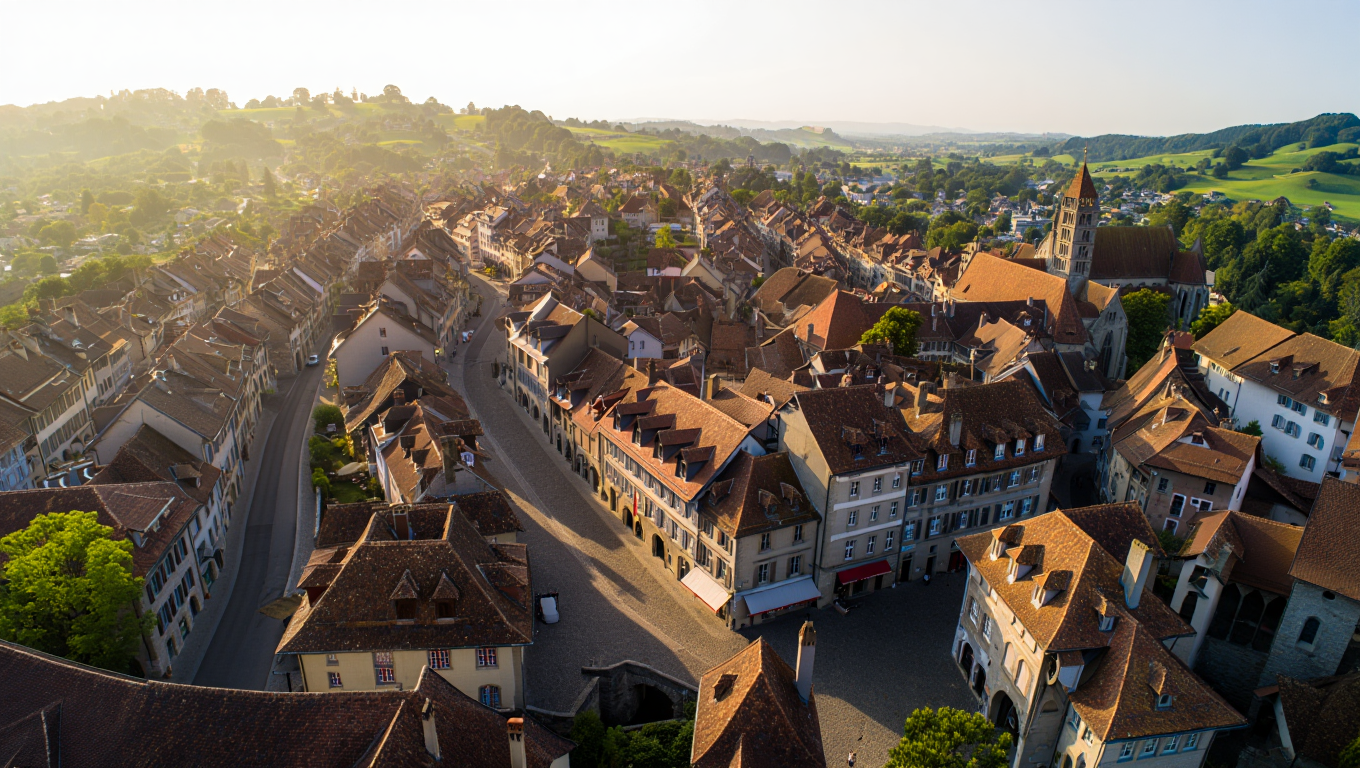
Old Fribourg is beautiful. To drive there, it is demanding.
The Basse-Ville packs narrow streets, cobbles, cyclists, pedestrians who cross without looking, and especially meeting zones where the limit is 20 km/h and pedestrians have absolute priority — even away from marked crossings.
Many candidates slow down in a meeting zone but do not really change behaviour. In these zones you must be ready to stop at any moment. The expert knows that — and checks whether you have internalised it.
Another issue: priority to the right in small old-town streets. On some stretches it applies where you do not expect it. Long hesitation or forcing your way without certainty will be noted.
Preparation is simple: drive these streets before the test — not on autopilot, but observing signs, markings and how the quarter works.
Trap 2 — Givisiez roundabouts and the A12 exit

Heading north out of town, tests often pass through Givisiez and the A12 area — where the road character changes completely.
Roundabouts here are large, multi-lane, and traffic flows faster than downtown. Candidates used to small urban roundabouts lose their bearings: they merge too late, or too abruptly without a proper blind-spot check.
The Fribourg-North A12 exit is another classic: deceleration. Leaving the motorway means 120 → 80 → 50 in seconds. Some forget the limit changes as soon as you leave the slip lane. Examiners watch that moment closely.
On the motorway itself, if included: merging from the hard shoulder and overtaking are high-attention moments. Never overtake on the right — in Switzerland it is an offence, and in the test it is a fail.
Trap 3 — 30 km/h zones

Fribourg has added many 30 km/h zones. Residential areas around the centre, school zones, some shopping streets — limits can change block by block.
The classic problem: entering a 30 zone at 48 km/h because you missed the sign, or saw it too late and braked too hard. Neither looks good.
Few candidates know how finely speeding penalties are graded in Switzerland. Exceeding by 16–20 km/h is a minor offence (fine and record). Beyond 20 km/h you enter a more serious band — with consequences for a probationary licence. For new drivers, a moderately serious offence can trigger withdrawal or an extended probation period.
During the test, clearly exceeding 30 in a signed zone risks immediate failure. After the test, fixed cameras around Fribourg apply the same rules.
Good habit: as soon as you see a 30 zone sign, check speed before entering, not after — two seconds of anticipation change everything.
Trap 4 — Hills (Fribourg is not flat)

This is one of Fribourg's clearest differences from flatter training towns: real gradients, ramps and descents in the old town and around Bourg.
Two situations catch people out:
Hill starts. Stopping at a sign or light uphill means moving off without rolling back. In a manual, it is the classic stall-and-panic moment; in an automatic it is usually easier, but releasing the brake too early still happens. The expert watches for calm, methodical control.
Descents and engine braking. In the Basse-Ville, some candidates let the car run instead of actively holding speed. Braking must stay progressive and the car under control. Arriving too fast at a stop at the bottom of a slope shows immediately — and not in your favour.
If you are not used to hills, practise them in lessons — do not discover them on test day.
Trap 5 — What the expert really watches in the cabin

This is not about a street — it is about you, inside the car, for 45 minutes.
The expert is not there to trick you. They assess whether you drive autonomously and safely. Yet some behaviours create a bad impression even when technique is solid:
- Looking at the expert before every move, as if asking approval — shows you are not autonomous yet.
- White-knuckling the wheel and never using mirrors — shows you are managing stress, not the road.
- Over-commenting your own mistakes — distracts and undermines you.
What scores well: regular mirror checks (interior + door mirrors), looking well ahead, and when in doubt choosing the safest option, even if it is slower.
If you are unsure who has priority, yield. Examiners prefer prudent to fast-but-hesitant.
For the full administrative path before the test, see our step-by-step Fribourg licence guide.
What if you commit an offence during the test?
It depends on the error.
A one-off technical slip — slightly rough braking, a wrong gear choice — is not necessarily a fail. The expert weighs the whole picture.
Some situations stop the test immediately: a clear Highway Code offence (running a red light, failing to give way to a pedestrian on a marked crossing, crossing a solid line), or anything the expert judges dangerous.
If the test stops or you fail, you will need more lessons before rebooking. Switzerland does not set a minimum gap between attempts, but the OCN will not send you back until you are ready.
How AZUL prepares you on these routes
Local knowledge is not improvised. At AZUL, practical lessons regularly use real routes seen in OCN Fribourg tests — the Basse-Ville, Givisiez roundabouts, peripheral 30 zones, Bourg hills.
The goal is not memorising one route, but being comfortable in situations you have already lived. When you enter a meeting zone and know how to behave because you have done it ten times in lessons, the expert notices.
Our instructors also train reading the environment — not only manoeuvres. A passed test is a candidate who drives with their head, not only their hands.
Preparing for your test in Fribourg? Book an assessment lesson with AZUL to see exactly what to work on before the big day. Book on agenda.ch.
Read also: Full Fribourg licence guide — from enrolment to the test · Choosing an instructor in Fribourg: trust and preparation

Prepare for your practical test in Fribourg with AZUL
Real routes, hazard perception and confidence — book an assessment lesson or a slot on agenda.ch.